What does an AI agent do when it needs your yes?
It stops, says exactly what it wants to do, and waits for you to press Approve or Deny. Its own work that can be undone it does without asking; anything that sends, pays or deletes waits for that press.
DETGAAO runs its own company on a team of AI agents, and Hamdoi is the screen we run them from. One agent drafts posts, one sorts the inbox, one builds software, one reads the website numbers. Between them they make a steady stream of small decisions, and almost none of them reach a person. A few do, on purpose, and getting those few right took more thought than anything else in the setup.
Which actions wait
The line we drew is simple enough to fit on a sticky note. If an agent's own work can be undone, it goes ahead. If it leaves the building or cannot be taken back, it asks.
Writing a draft is fine; publishing it waits. This post sat on a desk until a person said yes. Building a new version of the command centre is fine; putting it live waits, and the screen says plainly which version is live until someone approves the next one. Money is stricter still: an agent the command centre starts on a job has the money tools we know of refused on every call.
That rule matters more than any clever model. Ask a business owner what worries them about agents and you rarely hear about intelligence. You hear "will it do something I can't undo while I'm asleep". Put the line at undo, and that worry has an answer.
What the waiting looks like
When an agent reaches one of those actions, it pauses and puts a card at the top of the command centre. The card says who is asking, when, and the exact question, with two buttons under it. For a project marked private, like the demo below, the card says only that permission is needed and keeps the details off the shared screen.
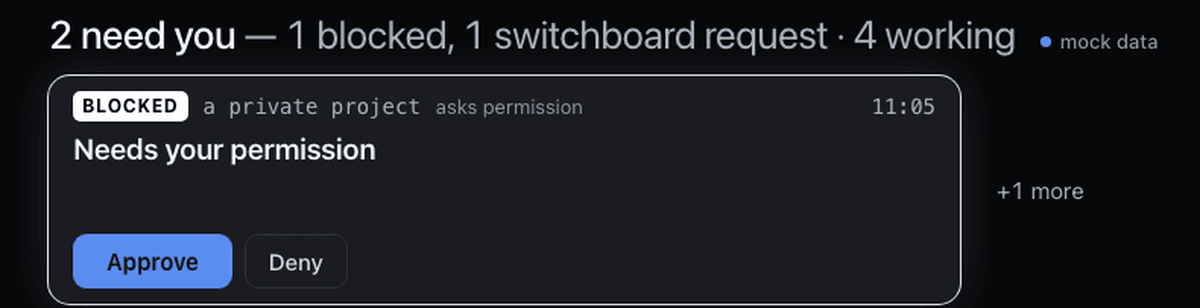
The first line of the screen is always a count: how many things need you right now. When it says nothing needs you, you can close the laptop. When it says two, you look at two cards and press two buttons. Nobody has to open a chat, scroll back through what the agent did, or guess what it meant.
The problem we had to solve first
An agent that asks permission is only useful if someone answers. An agent waiting on a question at 3 a.m. does nothing until a person looks, and with questions spread across separate windows, nobody knew where to look.
The fix had two parts. The command centre puts every waiting question in one place instead of scattering them across separate windows, so nothing waits unseen. And the same screen opens on a phone, over a private connection that only paired phones can use. A question that arrives over dinner gets a yes or a no from the table, and the agent carries on.
The lesson for anyone setting this up: design the asking and the answering together. An approval step without a fast way to answer just moves the bottleneck from the agent to you.
When agents ask each other
Agents also need things from each other. The agent that writes posts might need a short video; another agent makes videos. We did not want either of them to keep a list of who does what, because that list goes out of date the day a new agent arrives.
So an agent posts what it needs, and the command centre finds the agent that can do it. If no agent can, or two could, the request comes to you by name instead of being guessed at.
A few routine requests between agents, on a short list we chose, run by themselves. Three brakes sit on them: a cap on how many can run before a person next presses something (it also resets every morning), a limit on how many agents a request can pass through, and one switch that stops them all and holds them in a queue. The checks that stop an agent deleting things still apply on this path. Everything else arrives on your screen as a card with Approve and Deny, so two agents cannot quietly agree to do something you would have wanted to see.
No retries that spend
One detail took some thought. When a job fails halfway, the natural thing for software to do is try again. For most jobs that is right. For a job that costs money, a retry is a second payment nobody approved.
So when a job one agent handed to another fails, it is never retried automatically. It goes back on your list with what happened, and you decide whether to run it again. That costs one more press now and then, and in return nothing runs twice because a machine decided it should.
A record of who said yes
Every action the command centre carries out leaves a receipt, and the receipt records what allowed it: a yes from a person to that exact action, or one of the routine requests that ran on its own. The second kind says so plainly: nobody was asked.
That record is how the short list of routine jobs stays honest. You can see exactly what ran without you, and if something on the list should have asked first, the receipt shows it and the list gets shorter. Any decision to let agents do more starts from that record.
What to ask before you let agents near your business
If you are weighing agents for your own team, these are the questions we would ask of any setup:
- Which actions does it take without asking, and can you read that list?
- When it does ask, can you answer from your phone?
- If two agents work together, can they act on something neither was allowed to do alone?
- If a paid job fails, does it run again without you?
- Can you see, later, who approved each thing it did?
Our own answers are in this post, and they describe how DETGAAO runs. A team built for your business is shaped around how you already work, and it starts from one rule: nothing important happens without your yes. If you would like one built around yours, have a team built for your business.